
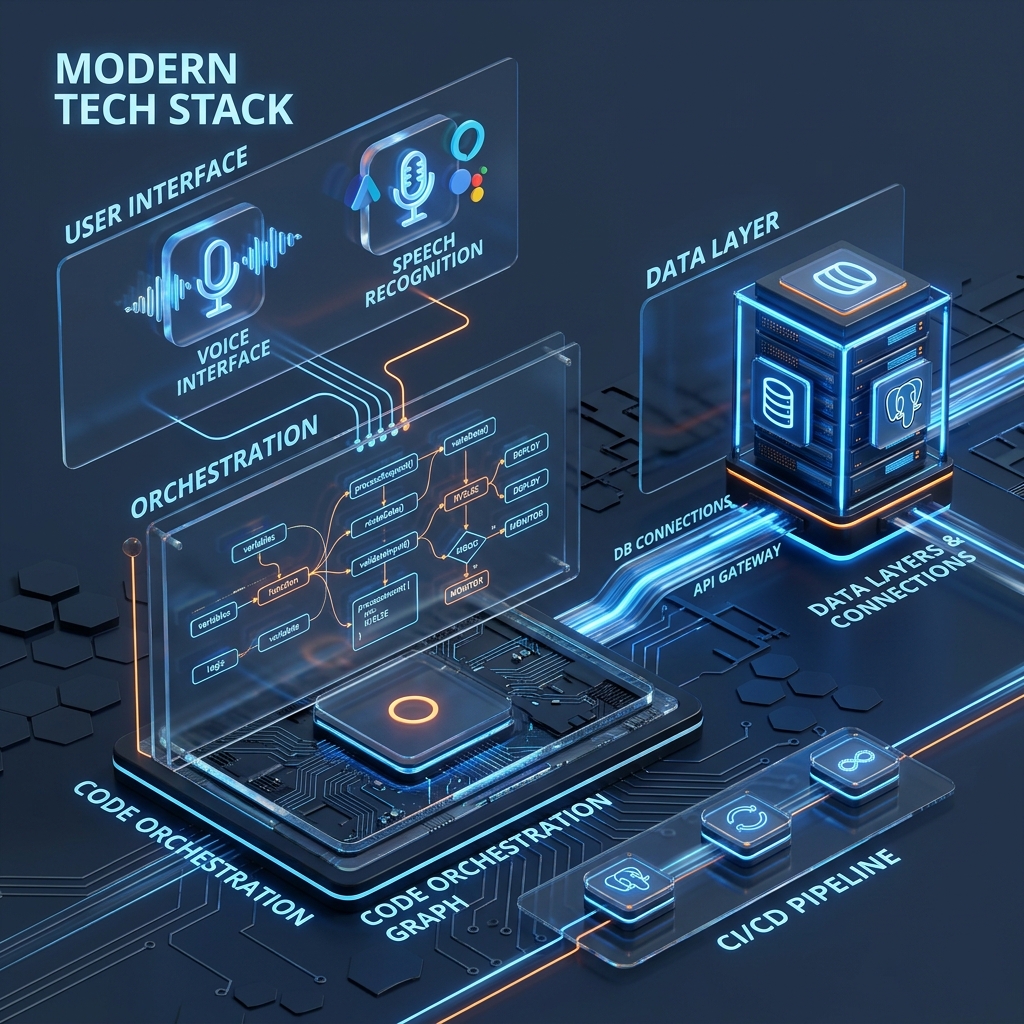
The AI landscape has shifted from basic chatbots to autonomous agent networks. Here is the modern tech stack we use to build real-world voice and workflow automations.
The AI landscape has shifted. We have officially moved past the phase of simple GPT wrappers and single-prompt chatbots. Today, the companies driving real operational savings are building **Agentic AI**—autonomous systems capable of reasoning, planning, executing workflows, and self-correcting. Here is the industry-standard tech stack we use to build these systems for our clients.
1. Voice AI: Vapi and Retell AI for Real-Time Phone Agents
The old days of frustrating IVR telephone menus ("Press 1 for support...") are dead. Companies are deploying human-sounding voice agents built on Vapi or Retell AI. These platforms manage the difficult engineering challenge of webRTC, speech-to-text, LLM processing, and text-to-speech with ultra-low latency (under 1 second). This means the AI can interrupt, react to emotion, and handle intake or sales calls just like a human operator, saving data directly into CRMs like Salesforce or HubSpot.
2. Agent Orchestration: LangGraph for Complex Cycles and Loops
While frameworks like LangChain are excellent for linear chains, real business logic is rarely linear. It requires loops, feedback blocks, and self-correction. For example, if an AI agent generates a piece of code or retrieves a document, it must test it; if it fails, it must loop back and try again. This is where LangGraph shines. It lets us model AI agent behaviors as state machines (graphs). We can build multi-agent teams where one agent researches, another drafts, and a third edits—passing state variables between them dynamically.
3. The Workflow Glue: n8n Node-Based Orchestration
To connect these advanced AI systems to your existing business stack (CRM, Slack, email, databases), you need an integration engine. While Zapier is popular, the developer-standard choice is n8n. It is self-hostable, handles advanced JSON structures, and has built-in, native nodes for LangChain, vector stores, and custom Python/JavaScript code execution. It allows us to build complex, conditional logic pipelines that trigger voice calls or document processing instantly.
4. Long-Term Memory: Vector Databases like Pinecone and pgvector
An AI agent is only as good as its context. To allow agents to answer questions about complex company wikis, legal contracts, or custom code, we use Retrieval-Augmented Generation (RAG) backed by vector databases. Pinecone is the standard for high-speed, managed vector search, while Supabase (pgvector) is preferred for relational database stacks. This allows us to convert your documents into vector embeddings so agents can query millions of pages of context in milliseconds.
5. Building Your Agentic Workflow Today
Integrating these technologies into your business stack doesn't require rebuilding your product. You can start by automating a single workflow—such as qualifying incoming leads using a custom AI automation workflow, or routing incoming calls through a Vapi agent. By starting small and building graph-based loops, you establish a highly reliable digital labor engine.
6. State Caching & API Token Cost Management
Running complex multi-agent flows can become prohibitively expensive if not optimized. Each time an agent loops in a framework like LangGraph, it passes the entire conversation history and context back to the LLM, increasing token usage. To reduce operational costs, developers must implement smart state management and caching. By caching intermediate steps and summarizing previous loop contexts, you can reduce API tokens by up to 50% while accelerating execution speed. GoPra Lab's architecture designs incorporate these caching mechanisms, ensuring that enterprise automations remain highly cost-efficient at scale.
7. AI Self-Correction and Exception Handling Loops
In a real-world B2B environment, an automation system cannot afford to crash when encountering unexpected data formats or API errors. Implementing self-correction loops is critical. For example, if an AI agent is tasked with parsing a customer invoice and extraction fails due to formatting, the error is caught, and a validator agent is triggered to rewrite the prompt with corrected instructions. This allows the system to resolve errors autonomously without human intervention, maintaining database consistency and operational stability.
8. Reference Agentic Architecture Stack
When designing an end-to-end voice and task automation pipeline, we use a structured integration layout. Here is the reference stack we deploy for our clients:
- Frontend/Client Interaction: Next.js custom portal providing low-friction UI and intake web forms.
- Voice Interface: Vapi / Retell WebRTC connection handling real-time speech and dial-in logic.
- Orchestration Layer: LangGraph handling state transitions, loops, and multi-agent roles (Researcher, Synthesizer, QA).
- Integration & API Router: n8n self-hosted engine directing workflows to Salesforce, Stripe, and Slack alerts.
- Memory Store: Pinecone (vector embedding database) and Supabase/PostgreSQL (structured transactional data).
By engineering systems using this robust stack, GoPra Lab helps companies deploy digital labor forces that scale operations cleanly. To review custom integration options, explore our Web Development and AI consulting divisions.